


The Clock in the Sky - Panchang
Updated: Jun 29
The Indic Festival Puzzle
After graduate school, I moved to a new city in the United States. Socializing with fellow Indians is something one looks forward to, quite earnestly if I may say so, and the obvious occasions are festivals. That is when I started noticing the prescribed timings, and the annual debate over who is celebrating when: Diwali puja on "Kartik, Amavasya, Pradosh Kaal," Ganesh Chaturthi on "Bhadrapad, Shukla Paksha, Chaturthi, Madhyahna Kala." What does any of it mean? I knew the festival names. I knew there would be food. I did not know why today, why the date slides around the Gregorian calendar every year, or why my festival fell on a different date than my cousin's back home.
The answer begins with one idea at the heart of the Indian worldview, the idea Advaita Vedanta carries to its peak and Erwin Schrödinger admired as "the doctrine of the Upanishads": one consciousness underlies everything, and the multiplicity is only apparent. If that is true, the cosmos is not a backdrop you observe. You are part of the same fabric. To live well, then, is to live in harmony with the whole, to sync yourself to the rhythms of what you are made of: Surya (the Sun), Chandra (the Moon), the Grahas (the Planets), the Tare (the Stars), and the Rutus (the Seasons), the observable brahmanda (cosmos) of the ancients. That is why a Panchang date looks so much more elaborate than a Gregorian one. A Gregorian date is a counter; it carries nothing beyond its own count. A Panchang date is a snapshot of the sky, an instrument for keeping a life in step with ṛta, the order of the universe. The rest of this essay unpacks that instrument.
The one picture everything hangs on
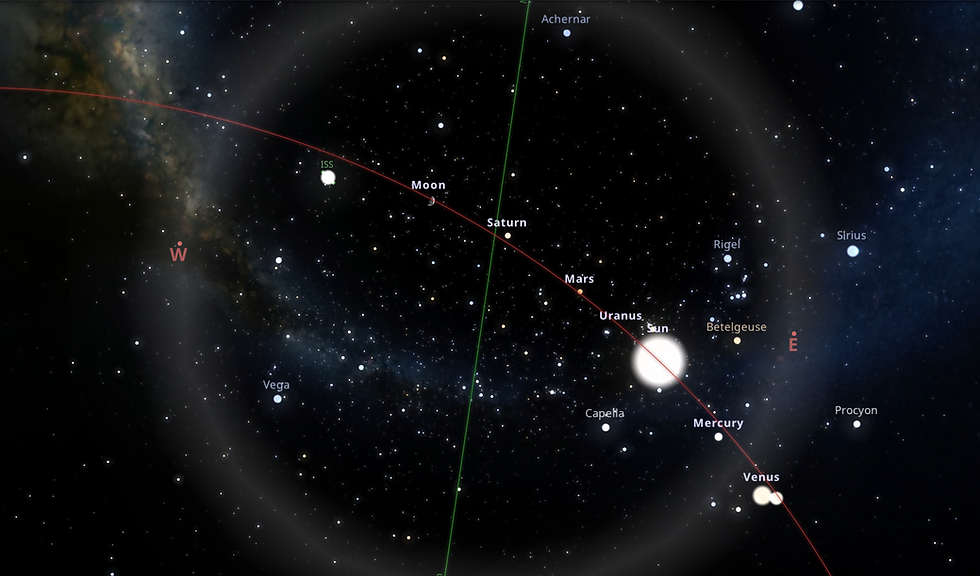
Stand outside and watch the sky for a year and you notice what the ancients noticed: Surya (the Sun) does not just rise and set. It slowly slides along a fixed path through the background stars, returning to where it started after one year. Chandra (the Moon) and the planets ride close to that same path. That highway in the sky is the Krantivritta (the ecliptic), and it is a circle, so it has 360 degrees. The move that turns sky-watching into a calendar is to slice that circle up, two different ways at once.

Surya marks four points on this circle, and they come straight from the Prithvi's (the Earth's) tilt. Picture the Prithvi's Madhya Rekha or Nirvikshepa Rekha (equator) pushed outward onto the sky: the Ghaṭikā Maṇḍala or Viṣuvan-maṇḍala (celestial equator). Because the Prithvi is tilted, Surya does not ride along it. It climbs above for half the year and sinks below for the other half, and the four moments that matter are the turns and the crossings. Around December 21 Surya reaches its southernmost point and turns back north: the shortest day, the start of Uttarayana, the northward journey. Around June 21 it reaches its northernmost point, the longest day, and turns south: Dakshinayana. In between, twice a year, Surya crosses the Viṣuvan-maṇḍala (celestial equator) dead on, at the Vasant Sampat Bindu (spring equinox) around March 20 and the Sharad Sampat Bindu (autumn equinox) around September 22. On those two days, day and night stand equal everywhere on Prithvi.
Two turns, two crossings: the skeleton of the solar year, the anchors of the seasons.


Marking zero on the ecliptic, and setting the grid
So where do you put the zero on the circle to make a ruler? Around 1,700 years ago, as tradition had long done, Indian astronomers used the Vasant Sampat Bindu as their zero. At that era's Vasant Sampat Bindu, Surya stood at the very start of the nakshatra sequence, at Ashwini. That point was marked zero degrees, and from it the Krantivritta was divided up.
And this zero was not the first. The most ancient nakshatra lists do not begin where ours do; they begin with Krittika (the Pleiades). Around five thousand years ago Krittika rose due east, because it then sat on the celestial equator, and a star on the equator rises at the exact eastern point, the same direction the equinox sun rises along. That made Krittika a fixed marker for true east. The Shatapatha Brahmana records this in passing, noting that the Krittikas alone "do not swerve from the eastern direction" while the other lodgings drift. As the celestial equator slowly wobbled onward, Krittika's rising point drifted off due east, the equinox crept along to Ashwini, and the later texts re-headed the lists to begin there. Hold that thought; what makes the equinox and the equator move is the deepest part of this story.
From zero, the first slicing gives 12 rashis (signs), each 30 degrees wide, tracking Surya: Mesha (Aries) from 0 to 30 degrees, Vrishabha (Taurus) 30 to 60, and so on around to 360. The second slicing is finer and more ancient: 27 nakshatras, each just over 13 degrees wide, tracking Chandra. Chandra circles the whole sky in about 27.3 days, roughly one nakshatra per night. Ashwini, Bharani, Krittika, Rohini, on through Revati: the names of those star-patches, Chandra's nightly lodgings.
Why 27, and how would a civilization without printing keep that number, and the finer facts behind it, alive for a hundred generations? The ancients' trick was to hide the data inside a story too good to stop retelling. Chandra marries the 27 daughters of Daksha on the promise of treating them all equally; the 27 daughters are the 27 nakshatras. But Chandra falls for one, Rohini, and lingers with her, neglecting the rest. The slighted sisters complain; Daksha curses Chandra to wither away; Chandra repents, the curse is softened, and so he wanes and waxes again, forever. Now unwrap it. Chandra's orbit is an ellipse, so he does not move at a steady speed; he hurries through some stretches of sky and lingers in others. The story records the 27 lodgings, the uneven speed (he lingers with one), and the monthly cycle of waning and waxing. Without the key, a myth about a faithless husband. With the key, an observational record of an elliptical orbit, built to survive being told around a fire for three thousand years.
Take one star as an example: Chitra (Western call it Spica), lying almost exactly on the Krantivritta. Remember it; it returns at the end of this story.

One more bit of vocabulary. You can count positions from the Vasant Sampat Bindu, the seasonal mark: the Sayana (tropical) way. Or you can count from the origin of a fixed star grid: the Nirayana (sidereal) way. Picture a rope knotted at zero and then at every 13 degrees 20 minutes, the knots named Ashwini through Revati. Find your chosen star in the night sky, hold its knot against it, wrap the rope around the Krantivritta, and the whole grid falls into place, origin and all, from that single star. That is Nirayana: you chase a star and track it. Sayana holds the rope differently, pinning the zero knot to the Vasant Sampat Bindu itself: you chase the equinox and track it. Same rope, two different nails.
That is the whole stage: a circle, two rulers laid over it. Everything else is keeping careful track of where Surya and Chandra stand on that circle. And "careful" is the right word. A star you actually see sits at some angle above your local horizon, in a sky that wheels overhead all night; converting that raw sighting into a stable coordinate on the Krantivritta takes real spherical geometry, and the texts spell out exactly how. That is the fingerprint of people doing real astronomy, not stargazing and guessing.
Computing celestial measurements
Once the origin is set, we can lay down the grid for every 30 degree for Surya and every 13 degree 20' for Chandra. Every time Surya crosses into the next 30 degree band you have a Sankranti, twelve a year. Makar Sankranti is Surya entering the band of Makara (Capricorn). And here is the part that should startle you: the entire daily machinery of the Panchang reduces to tracking just two angles, where Surya is and where Chandra is, on that one circle.
The ancients maintained those two angles with siddhantas: handbooks of orbital constants and correction tables, refreshed by observation, from which a trained jyotish could compute the sky for any date. The modern descendant of those tables is the Development Ephemeris from NASA's Jet Propulsion Laboratory. An ephemeris is exactly what a siddhanta was: a machine for answering "where was, or will be, every body in the sky at this instant." JPL builds it by numerically integrating the equations of motion of the entire Saur-Mandal (solar system), then fitting the result to decades of hard measurement: radar ranging to the planets, tracking data from interplanetary spacecraft, and laser pulses bounced off reflectors that Apollo astronauts left on Chandra's surface, which pin Chandra's distance to within centimeters. DE421 covers the years around our own; DE441 stretches from 13,200 BCE to 17,191 CE, for reading ancient skies. Three thousand years separate the Surya Siddhanta from DE421. The job description has not changed.
With the Skyfield library reading that ephemeris, the core of the Panchang is a few lines of Python (Simplified code below):
from skyfield.api import load
from skyfield.framelib import ecliptic_frame

ts = load.timescale(); eph = load('de421.bsp')          # NASA JPL ephemeris
t = ts.now()
e = eph['earth'].at(t)
_, sun_lon, _  = e.observe(eph['sun']).apparent().frame_latlon(ecliptic_frame)
_, moon_lon, _ =
e.observe(eph['moon']).apparent().frame_latlon(ecliptic_frame)

tithi = int(((moon_lon.degrees - sun_lon.degrees) % 360) / 12) + 1
# 1..30

ayanamsa  = 23.853 + 50.29 * (t.tt - 2451545.0) / 365.25 / 3600
# Lahiri (approx.)

nakshatra = int(((moon_lon.degrees - ayanamsa) % 360) / (360 / 27))
# 0=Ashwini .. 26=Revati
Read the last three lines carefully, because they quietly contain this whole essay. The tithi line uses no correction at all; it is pure Surya-Chandra geometry, the same in any frame. The nakshatra line needs an extra number, the ayanamsa, subtracted before it can point at real stars on our star grid. What that number is, why it exists, and why it is slowly pulling your festivals out of season: that is where we are headed. First, the five limbs.
Five facts in one date
The word Panchang means "five limbs." A Panchang date is not one number; it is five facts about where Surya and Chandra stand right now.
Tithi, the lunar day, is the heart of it. Picture a race: Surya and Chandra both run around our circular track in the same direction, but Chandra is much faster. The tithi counts how far Chandra has pulled ahead: every 12 degrees of lead is one tithi. Neck and neck is Amavasya (the new moon). Exactly 180 degrees ahead, Chandra sits opposite Surya, fully lit: Pournima (the full moon). The stretch where Chandra pulls ahead and brightens is the bright fortnight, Shukla Paksha; where he falls back and dims, the dark fortnight, Krishna Paksha. The tithi already tells you Chandra's exact phase. Your phone's "the fourteenth" tells you nothing of the kind.
But here is a subtlety, and it explains a thousand family arguments. Remember the Rohini story: Chandra's speed is not constant. So a tithi, a fixed 12 degrees of separation, takes a variable amount of time, as short as about twenty hours or stretching past twenty-six, while the civil day stays a fixed twenty-four. The classical rule for reconciling them: whichever tithi prevails at your local sunrise names your whole civil day. The consequences follow mechanically. A long tithi can be present at two consecutive sunrises and gets counted twice: tithi vriddhi. A short tithi can begin after one sunrise and end before the next, never owning a sunrise at all: tithi kshaya, the skipped tithi. And since sunrise itself shifts with longitude, two cities can wake under different tithis. This is why your Panchang and your cousin's can honestly disagree by a day. Both are right; they are reading the same sky through different sunrises.
It is worth saying plainly that the sunrise rule was, I argue, an operational convenience, not a law of the sky. In an era when every computation was cumbersome, one observation per day anchoring everything was sensible engineering. Today an ephemeris on a phone gives the exact moment a tithi begins and ends, to the second, anywhere on Prithvi. The convention deserves to be dialed back toward the actual sky-moment it was always approximating.
And now I can finally answer the question I could not understand: why my Diwali and Diwali in India fell on different dates. The instant Chandra enters the Amavasya band is one single moment for the whole planet. Suppose it lands at 2 pm on a Tuesday in Chicago; that is half past midnight Wednesday in India. India wakes Wednesday with Amavasya prevailing at Sunrise, so Wednesday is the Amavasya day; the tithi runs through that night till, say 10 pm, covers the Pradoṣa Kāl after sunset, and the diyas are lit Wednesday evening. In Chicago the same tithi began Tuesday afternoon, already covers Tuesday's Pradoṣa Kāl, and is finished before Wednesday's sunset; follow the Indian date and you would be lighting lamps after the tithi has left the sky. So I celebrated on Tuesday evening, roughly while my cousin was waking up to begin his Amavasya. Same sky, same instant, one sunrise apart on paper, and both of us correct. Which sharpens the earlier point: the sunrise rule and the kāla windows it feeds are local conventions layered on a global event. The Panchang's true subject is the sky's instant, not anyone's sunrise, and a tradition now spread across every longitude has one more reason to compute the moment itself.
And the tithi was never mere bookkeeping; life was tuned to it. The eleventh tithi of each fortnight, Ekadashi, is the traditional fasting day: twice a lunar month, a fast arriving every fourteen days or so, year after year, for life. In 2016 the Nobel Prize in Medicine went to Yoshinori Ohsumi for uncovering the mechanisms of autophagy, the cellular self-cleaning program that fasting switches on. It wired a recurring fast into the calendar itself, keyed to Chandra, so that the discipline never depended on anyone's willpower or memory. Live by the Panchang and periodic fasting simply happens to you.
Vara is the weekday, and it is quietly the same in every culture. The seven days are named for the seven things the ancients saw moving against the stars: Ravivar (Sunday) for Surya, Somvar (Monday) for Chandra, Mangalvar (Tuesday) for Mangal (Mars), Budhvar (Wednesday) for Budh (Mercury), Guruvar (Thursday) for Guru (Jupiter), Shukravar (Friday) for Shukra (Venus), and Shanivar (Saturday) for Shani (Saturn). The order is the lovely part, and it falls straight out of the planets' speeds. List the seven not by brightness or rank but by how fast each moves against the background stars, slowest to fastest: Saturn first, taking nearly thirty years to circle the sky, then Jupiter, Mars, the Sun, Venus, Mercury, and finally the Moon, which laps the whole sky in about twenty-seven days. That single ordering by speed is the key to the entire week.
An old scheme, laid out in the Surya Siddhanta, hands each hora (hour) of the day to one planet, stepping through that speed-ordered list over and over, and whichever planet rules the first hour gives the day its name. Now do the arithmetic. Twenty-four hours is three full cycles of seven, plus three left over, so the first hour of each new day lands three planets further down the list than the day before. Start from Surya and count three along the speed order, past Shukra and Budh, and you land on Chandra. That is why Ravivar is followed by Somvar, in India, in Rome, everywhere. You use a piece of planetary arithmetic every week without knowing it.
Nakshatra is which of the 27 star-lodgings Chandra is parked in front of tonight. Notice the difference from tithi: a tithi is just an angle between two moving bodies, but a nakshatra is a claim about real stars in a real sky, Chandra's physical address. This is also where the months get their names. A lunar month is named for the nakshatra its Pournima (full moon) falls in: Chaitra is the month whose full moon sits near Chitra, Vaishakha takes its name from Vishakha, Jyeshtha from Jyeshtha, and so on through twelve naming-stars spaced about a sign apart. The month's name is a label read off Chandra's position on full-moon night.
Yoga and karana are the last two limbs: yoga adds Surya's and Chandra's positions from same origin and slices the total into bands - cumulative travel placed into a band. So a total travel is reset at 360 degrees - so 400 degrees is 360 + 40 = 40 degrees. So, 40 degrees is placed in a band to map it to a yoga; a karana is half a tithi, 6 degrees. Useful for fine-grained almanac work, less central to the story for now.
One footnote that saves a lot of confusion: in much of the south a lunar month runs Amavasya to Amavasya; in much of the north, Pournima to Pournima. Same sky, same days, bracketed differently, like two companies whose fiscal years start in different months. Worth knowing before you argue with an Indian about which month it is.
So when you hear "Chaitra Shukla Pratipada," you can unpack it completely: the first day of the bright fortnight of the month whose Pournima falls near Chitra, with Chandra freshly past Surya, zero to twelve degrees ahead. The takeaway is simple and a little startling: a Panchang date is a snapshot of the sky. Tell me the tithi and the nakshatra and I can tell you, without looking anything up, where Chandra is and what shape it is tonight. The date is the sky. It is not complicated for its own sake; it carries far more information than a Gregorian date ever could.
A clock made of breaths
Long before mechanical clocks, ancient India built one of the most elaborate timekeeping systems in the world, and anchored it to the human body. The reference points were a breath and a blink: a prāṇa, one quiet breath, about four seconds; a nimeṣa, the closing of an eyelid, a fraction of a second. From there the system scaled with mathematical neatness: breaths into a pala (24 seconds), palas into a ghaṭikā (24 minutes), two ghaṭikās into a muhūrta (48 minutes), sixty ghaṭikās into one full day and night. The hora, a twenty-fourth of the day (2.5 ghaṭikās). Ordinary life ran on eight praharas, the three-hour watches marked at temples and forts by the stroke of a gong, and the day kept its sacred hours too: the Brahma Muhūrta before dawn, prized for meditation, and the sandhyā twilights at sunrise and sunset, set aside for prayer.
These units were measured, not imagined. The ghaṭikā-yantra, a copper bowl with a precisely drilled hole, floated on water, filled and sank in exactly one ghaṭikā, whereupon an attendant struck the gong. Kautilya's Arthaśāstra specifies the device for official timekeeping, and adds a shadow-length table for the śaṅku, the vertical gnomon whose shadow gave the hour, the cardinal directions, and the solstices. Time scaled from the blink of an eye to the breathing in and out of the cosmos itself, and it was never a line. It was a wheel.
One more word before the festivals: kāla. A kāla is simply a named window of time, and the day carried a standard set of them. Daylight, sunrise to sunset, was cut into five equal parts: Prātaḥ Kāl, the early morning; Saṅgava, the forenoon; Madhyāhna Kāl, the midday fifth; Aparāhna, the afternoon; and Sāyāhna, the closing stretch toward sunset. Because each is a fifth of daylight, the windows breathe with the seasons, stretching in summer and shrinking in winter; nothing about them is frozen clock-time. Sunset then opens its own set, beginning with the Pradoṣa Kāl, the roughly two muhūrtas after sundown when day surrenders to night.
And the divisions still govern when things happen. Remember harmony with the cosmos? Diwali's Lakṣmī Pūjā is performed in the Pradoṣa Kāl and the home is lit to invite prosperity in. Ganesh Chaturthi is celebrated in the Madhyāhna Kāl, because tradition holds Ganeshji was born at noon, so his murti is installed while Surya stands at its height. When a family fixes a wedding, a muhūrta is chosen, one forty-eight-minute sliver of the day, so the couple begins on a current of favorable time. The ancient grid of breaths and ghaṭikās is not a relic; it is the reason a ceremony begins at dusk, at noon, or at one precisely chosen moment and not another.
But separate the culture from the superstition here, the wheat from the chaff. The Vedanga Jyotisha and the Surya Siddhanta are books of computation; you will find no fortune-telling in them. A muhūrta is a 48-minute window, nothing more: ancient India kept its schedule synced to one shared sky, a village-scale calendar for when to plant, marry, and pray. Somewhere the schedule froze, the meaning faded, and fear and greed moved into the vacancy, as they always do.
Two clocks that refuse to agree
Now the problem that forced all the clever machinery into existence, the same problem every old civilization hit. Chandra hands you a natural month that is dyanmic and easy to observe: Amavasya to Amavasya, about 29.5 days. Twelve of those make about 354 days. But Surya runs the seasons, and the solar year is about 365 days. The lunar year runs 11 days short, every single year.
Do nothing and the two drift apart fast; in three years the gap is over a month and your festivals slide backward through the seasons. You can watch this in a purely lunar calendar: Ramadan, uncorrected by design, moves about 11 days earlier each year and walks through every season over three decades. The Indian calendar refused to allow that, because its festivals are married to seasons, harvests, solstices. It needed a way to keep nudging the lunar count back into step with Surya.
The fix: occasionally insert an entire extra month, and the rule for when is the elegant part. In a normal lunar month, exactly one Sankranti occurs. But a lunar month (29.5 days) is slightly shorter than Surya's stay in one sign (about 30.4 days), so the Sankranti slips about a day later inside each successive lunar month. Every two and a half years or so it slips clean past the end of a month, and you get a lunar month with no Sankranti inside it at all. That orphan is the Adhik Maas, the extra month, inserted as a repeat, since Surya never changed signs during it, handing the lunar calendar its 11 days back. This happens about seven times every nineteen years, a rhythm so dependable the Greeks found it too and named it the Metonic cycle.
So you can now answer the festival question yourself: a festival drifts a week or two against the English calendar because it rides Chandra, not Surya, and every few years a leap-month is stitched in to keep it honest with the seasons: Surya. The calendar is breathing against the solar year. And be clear about what the Adhik Maas is: bookkeeping, not astronomy. Nothing strange happens in the sky during a leap-month; it is the same accounting patch as a leap-day in February, keeping mismatched counters aligned. The sky-position a festival cares about, a particular tithi with Surya in a particular sign, returns every year, right on schedule. The leap-month only changes the name we file that moment under, never whether it happens.
The slow wobble
Everything so far would hold still if the sky held still. It does not, and this is where the calendar gets deep. Remember the equinox sliding from Krittika to Ashwini? Here is what was doing the sliding.
The Prithvi spins like a top, once a day. But a spinning top does something else: its axis slowly traces a cone. It wobbles. The Prithvi's full wobble takes about 25,800 years. This is precession. Its practical effect: the Vasant Sampat Bindu very slowly creeps backward against the background stars, about one degree every 72 years, roughly 50 arc-seconds a year. Tiny. But it never stops, and it adds up.

Now, a bright star is easy to find on any clear night, while pinning down the exact equinox takes patient, disciplined observation. Over time Indian astronomers leaned toward the easier path and fixed the frame to stars, and because the drift is so slow, the switch felt harmless: notice the signs of decay in knowledge. Different regions fixed on different stars, and a bouquet of regional panchangs flourished. But a star-anchored zero and an equinox-anchored zero pull apart by that same degree every 72 years. The growing gap has a name: the ayanamsa, the same number you saw in the code.
Since the equinox sat at Ashwini 1,700 years ago, the two frames have pulled about 24 degrees apart, roughly 24 days. And you can see the damage on any Panchang today. Makar Sankranti was created to mark Uttarayana, the true shortest day, around December 21, when Surya begins its northward turn:
When | Makar Sankranti fell on |
about 1,700 years ago | December 21, the actual winter solstice |
about 1,000 years ago | December 31 |
about 500 years ago | January 7 |
today | January 14 or 15 |
about 600 years from now | January 21 |
Leave it alone and it keeps sliding, into February, and over many thousands of years through the whole calendar before circling back. That is the price of nailing a seasonal festival to a fixed point in the stars.
Lahiri: the sky of 285 CE, frozen
If India was going to use a star-based zero, the question after independence was how to standardize it across all those regional panchangs. The government's Calendar Reform Committee took it up in the 1950s and chose what is now called the Lahiri (Chitrapaksha) ayanamsa, the system behind nearly every printed almanac you will meet, including the Rashtriya Panchang and the popular household editions.
Its definition is exactly the kind of star-anchoring we have been describing. Take the bright star Chitra (Spica), the one I asked you to remember, sitting almost on the Krantivritta. Pin it permanently at the 180 degree mark of the sidereal circle, the start of Tula (Libra): hold the rope's 180 degree knot against Chitra, and the origin back-calculates itself, every nakshatra and rashi boundary following with it. In practice: locate Chitra fresh from observation or NASA data, declare it 180, and the whole ruler unrolls from that one nail.
Why Chitra at 180? Because that reproduces the sky of roughly 285 CE, the era when the Vasant Sampat Bindu stood opposite Chitra, at the start of Ashwini, and the Sayana and Nirayana zeros coincided. At that moment the ayanamsa was zero. It has grown by 50.29 arc-seconds a year since, and stands a little past 24 degrees today. That is why the code earlier subtracted about 24 degrees before naming Chandra's nakshatra, and why Makar Sankranti sits in mid-January.
So in effect, the committee froze the sky of seventeen centuries ago and made it the national standard. The deeper question is one of philosophy. The order this whole Indic tradition is named for, ṛta, the deep rightness of how things move, was never meant to be frozen. The equinox moves. The sky turns. A calendar true to that spirit should track the living sky, not bolt itself to one long-gone equinox for eternity.
Sayana or Nirayana? Both, each for its own job
Here is the resolution that finally made the whole thing click for me: use the seasonal zero for time, and the star zero only for stars. I would go further: there are two errors here for a future calendar committee to undo. The first was made centuries ago, fixing the frame to a star because a star is easier to observe than an vasant sampat bindu - proper motion of stars is negligible. The second came after independence, when standardization doubled down on the first and froze it as the national norm.
Almost everything in the calendar is really about time and seasons: the tithi, the solar months, Makar Sankranti, the new year, the leap-month rule. Measure all of it from the vasant sampat bindu (equinox) and it stays locked to the seasons forever, correcting for the wobble automatically, with no star to maintain and nothing to drift. Exactly one thing genuinely needs a star: the nakshatra. It is, by definition, a patch of real sky with real stars in it; to say Chandra is "in Rohini" you must know where the Rohini stars actually are tonight, and the wobble cannot tell you that. Only a star can. I had a stubborn engineer's objection here: if a computer knows the wobble, why need stars at all? For the time-and-seasons half, you don't. But a nakshatra is a statement about stars; somewhere, you must point at one.
And the tradition itself agrees, if you read it carefully. In the Vishnu Purāna, Maharshi Parāshara teaches that Uttarāyaṇa begins when Surya enters Makara and the day is shortest, and ends when Surya enters Karka (Cancer) and the day is longest. Notice: that pairing holds only in the Sayana frame. Step outside on January 14, when Surya enters Nirayana Makara, and the shortest day is already three weeks gone. The sky itself arbitrates, and it sides with the seasons. The texts tied the ayanas (6 month period) to the turning points of Surya, not to a star-frame frozen in one century.
So the next time a colleague asks why tonight and not some other night, you have the real answer. The date is the sky: a tithi counting Chandra's lead over Surya, a nakshatra naming the stars he lodges among, a kāla choosing the very hour, a leap-month quietly keeping it all honest with the seasons. Behind one line on a Panchang stand millennia of watching, encoding, and correcting: a civilization's longest experiment in living in step with the cosmos it belongs to. Ṛta was never a frozen rule. It is the order of things in motion, and a calendar worthy of the name keeps moving with it.
Notes and references
The sky in the texts
The Daksha-Chandra-Rohini myth (Mahabharata, Harivamsa, Puranas): the 27 nakshatras, Chandra's uneven (elliptical) speed, and the waxing/waning cycle. The reading of such narratives as encoded astronomy owes much to Subhash Kak and the archaeoastronomy of Raj Vedam.
The Shatapatha Brahmana (2.1.2.3): the Krittikas "do not swerve from the east," read as the Pleiades at the vernal equinox around 4,000 years ago; the shift of the nakshatra list-head from Krittika to Ashwini as a record of precession.
Erwin Schrödinger, What Is Life? (1944), epilogue, on the Upanishadic identity of subject and object.
Timekeeping and the Panchang
The ghaṭikā / muhūrta divisions and the water clock: Vedanga Jyotisha and the Surya Siddhanta; the śaṅku gnomon and official water-clock: Kautilya's Arthaśāstra.
The planetary-hour basis of the weekday order: Surya Siddhanta and Aryabhatiya.
Intercalation: luni-solar constants of the Surya Siddhanta; intercalary months acknowledged from the Vedanga Jyotisha era, rule-based form solidifying in the Siddhantic period (~400 CE).
Yoshinori Ohsumi, Nobel Prize in Physiology or Medicine, 2016, for discoveries of mechanisms for autophagy, the cellular recycling process activated by fasting.
Precession, the ayanamsa, and the two zodiacs
Hipparchus's discovery of precession (c. 127 BCE) using Spica's shift; the precession-rate refinement across centuries (Aryabhata ≈48″, Bhaskara II ≈49–51″, Chandrasekhara Samanta ≈49.2″; modern value ≈50.3″ per year).
Lahiri (Chitrapaksha) ayanamsa: Chitra (Spica) fixed at 0° sidereal Tula; J2000 value ≈ 23°51′; adopted by the Calendar Reform Committee in the 1950s; zero-ayanamsa epoch ≈ 285 CE.
The Sayana/Nirayana domain split, tropical for time, seasons, and months, sidereal for nakshatras, and the Vishnu Purāna 2.8 argument: P. V. R. Narasimha Rao, vedicastrologer.org.
Computation
NASA JPL development ephemerides (DE421 for the modern range; DE441, spanning 13,200 BCE to 17,191 CE, for ancient dates), built from numerically integrated solar-system dynamics fitted to radar ranging, spacecraft tracking, and lunar laser ranging.
The Skyfield astronomy library (Python), for ephemeris access and coordinate transforms. Note: Skyfield's ecliptic_frame is the true ecliptic and equinox of date, i.e., Sayana longitudes, which is exactly what tithi and ayanamsa subtraction require.


Comments